
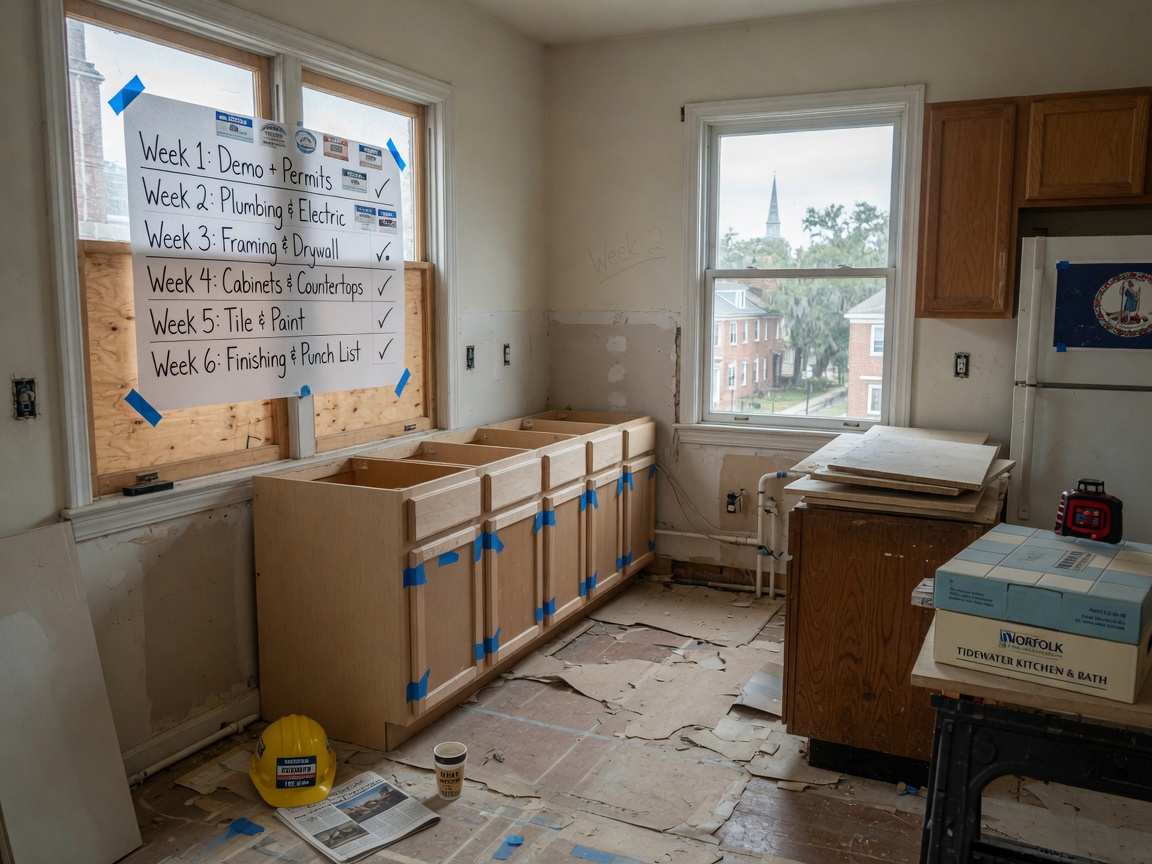
Churchland is part of the City of Portsmouth, which surprises people because it sits nowhere near Olde Towne and borders Chesapeake's Western Branch directly. That means your permit runs through Portsmouth while a neighbor a few streets away pulls a Chesapeake one. Worth confirming before comparing two quotes that look similar on paper.
It also does not carry the tunnel problem that defines the rest of our Portsmouth work. We reach Churchland via I-664 or the West Norfolk Bridge rather than the Downtown or Midtown Tunnel, roughly 25 minutes from Colley Ave, so the arrival time we quote actually holds.
The housing has essentially nothing in common with the historic side of the city. Churchland is postwar suburban expansion, mostly 1950s through 1970s ranches and split-levels with later infill. Framing is square, openings are standard, and there is no plaster or knob-and-tube to work around. What there often is: a 100 amp panel that will not carry an induction cooktop plus new lighting circuits, and a floor plan that seals the kitchen off from the rest of the house. Opening that wall is usually the change worth making, and on a split-level it typically carries load.
Around Churchland
We regularly work near:
- 📍Churchland Boulevard
- 📍High Street
- 📍West Norfolk Bridge
- 📍Churchland Park
- 📍I-664
- 📍Western Branch of the Elizabeth River
Kitchen Remodel Norfolk in Churchland — Local Notes
- •Churchland is part of Portsmouth, so permits run through Portsmouth despite the neighborhood bordering Chesapeake's Western Branch.
- •Access is via I-664 or the West Norfolk Bridge rather than the tunnels, making scheduling here more reliable than Olde Towne or Cradock jobs.
- •Housing is postwar suburban, mainly 1950s to 1970s ranches and split-levels, with none of the plaster or original wiring found in historic Portsmouth.
- •Panels in this era are frequently 100 amp and need upgrading before an induction cooktop and new lighting circuits will fit.
- •Closed-off floor plans mean opening the kitchen to the dining or family room delivers the most value; on split-levels that wall usually carries load.